

A complicated game
Who gets credit for Order of the Sinking Star? Where should the names appear for the creators of its source material? And would you notice if a great game designer sat next to you?

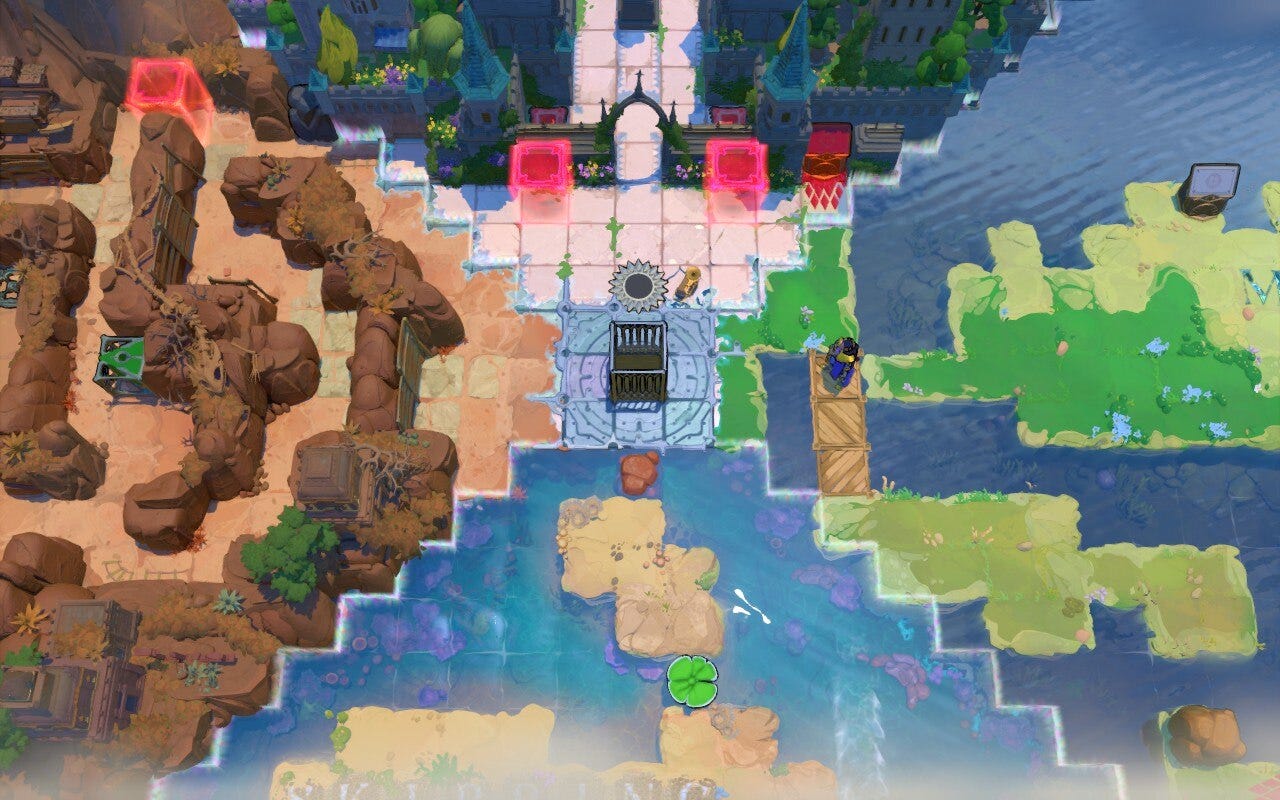
Early last month, while playing the Switch 2 version of the big, upcoming puzzle game Order of the Sinking Star, I stumbled across a surprising piece of text.
The game is developed by a studio called Thekla for PC, PS5 and Switch 2 and is played from an overhead view. In the center of its massive map, players control a queen. She moves across a strange land filled with over 1,000 block-pushing puzzles, one grid square at a time. I’d made her venture to the greenery in the east, a portion of Sinking Star’s map called The Mirror Isles. That region is full of clever puzzles about reflections, and it is based on a 2014 puzzle game called Mirror Isles.
At the entrance to the zone, I’d found a sign rendered in the fashion of a slab like you might see in front of artwork at a sculpture garden. As the queen approached, text appeared on the screen: “Instigator: Hazelden, A.”
I understood this to be a reference to Alan Hazelden, the puzzle game designer who in 2016 had given Sinking Star lead creator Jonathan Blow, himself an acclaimed puzzle game designer, permission to base a portion of the new game on Mirror Isles.
Four big chunks of Sinking Star are based on small indie-developed puzzle games, all licensed with permission. The south of the map is based on another Hazelden game, Skipping Stones to Lonely Homes. Sinking Star’s north and west are based on two other designers’ games, Jonah Ostroff’s Heroes of Sokoban trilogy and Sean Barrett’s Promesst series.
By the time I was playing Sinking Star, all four had publicly distanced themselves from Blow over comments he’d made in the past. That made the appearance of Hazelden’s name so prominently in the version I played interesting and unexpected.
Two weeks later, when I played another version of the game, Hazelden’s name was gone from that spot.
A bold game’s unusual debut
Back in December, at a less controversial moment, I’d spoken to Blow about Order of the Sinking Star, ahead of its unveiling at The Game Awards. He’d described the game’s origins, first as a project he’d intended to be tiny, just a proving ground for a new programming language he was creating. “I should have known that it would turn big,” he said. “But for some reason I was like, ‘No, we’re gonna make a small game.”
The math behind Sinking Star’s concept had forced it to become immense. The game’s conceit is that players learn the rules of the puzzles in each of the four areas and then discover how each areas’ rules mix with the others, where they share borders. In the northeast, for example, the gameplay systems based on Heroes of Sokoban cross over with the rules governing The Mirror Isles. Across the map, at the six borders where the regions touch, the combinatory effects produce a multiplicity of puzzle game ideas.
Back then, ahead of the announcement, Blow told me that the four source games he’d chosen years ago were “made by some of the best designers in the world, who nobody really knew at that time.”
When I realized that two of them were by Hazelden, I was delighted. Just two months earlier, I told Blow, I’d become enamored with Spooky Express, which Hazelden had designed alongside a puzzle maker Hazelden admired named Lucas Le Slo. Between that and my introduction to Order of the Sinking Star, I was coming to appreciate how puzzle game designers share their talents with each other and intermingle their expertise.
Blow and I briefly discussed A Monster’s Expedition, a lovely puzzle game Hazelden had led. It’s about rolling logs and making bridges across a scattering of islands. Solving one of its puzzles leads to a memorable epiphany about something else the logs in the game can do. Blow recalled this moment. “That is definitely one of the features of his games, is they have those surprises,” he said.
Three days after Blow and I spoke, just before 9pm ET on December 11, Order of the Sinking Star was revealed via a Game Awards trailer.
Within a few minutes, Hazelden posted about it.1 He called it “a great concept” and listed the source games’ creators, linking to their work, emphasizing that Sinking Star was made by a team—though he did not work on it—and then distancing himself from Blow.
He wrote that: “…in recent years it has become increasingly clear that Jon’s beliefs/priorities and mine are not aligned.” Hazelden said Blow was “adversarial to people talking about privilege and representation, is dismissive of diversity efforts.” He labeled him “pro-MAGA.”
(Blow did not respond to the thread, as far as I can tell.)
Soon, the designers of the two other games sourced for Sinking Star said on their social media feeds that they agreed with Hazelden’s praise for the game and criticism of Blow.
It’s remarkable enough to see a whole game based on the idea of polishing, expanding and then intersecting four existing games, all used with permission.
It’s all the more unusual to see the makers of those games separate themselves from the recognized lead creator of the project.
Initial coverage of Order of the Sinking Star didn’t cover this. Reporters had seen the game ahead of The Game Awards reveal, and many published their coverage when the embargo lifted, without plausibly knowing of the source developers’ dissent.
In late January, Bloomberg wrote about the controversy, citing Blow’s mocking of someone on Twitter/X for using pronouns in their bio, for calling Donald Trump, in early 2025, “the best President we have had in my entire life, by far.”
Blow declined to comment on the controversy to Bloomberg. Instead, that article quoted the head of Sinking Star’s publisher, Arc Games, saying Blow’s political views “were not taken into consideration” when they signed the game. Arc had simply considered the game to be promising, they said.
Hands-on in LA
This past June, I was playing a development build of Order of the Sinking Star on a Switch 2 at Nintendo’s section of a Summer Game Fest showcase in Los Angeles Summer Game Fest. It was the last game I’d be able to see, as the three-day event was minutes from shutting down. Each game at Nintendo’s event had its own space, most of them set up to feel like small living rooms, with chairs and couches near a TV.
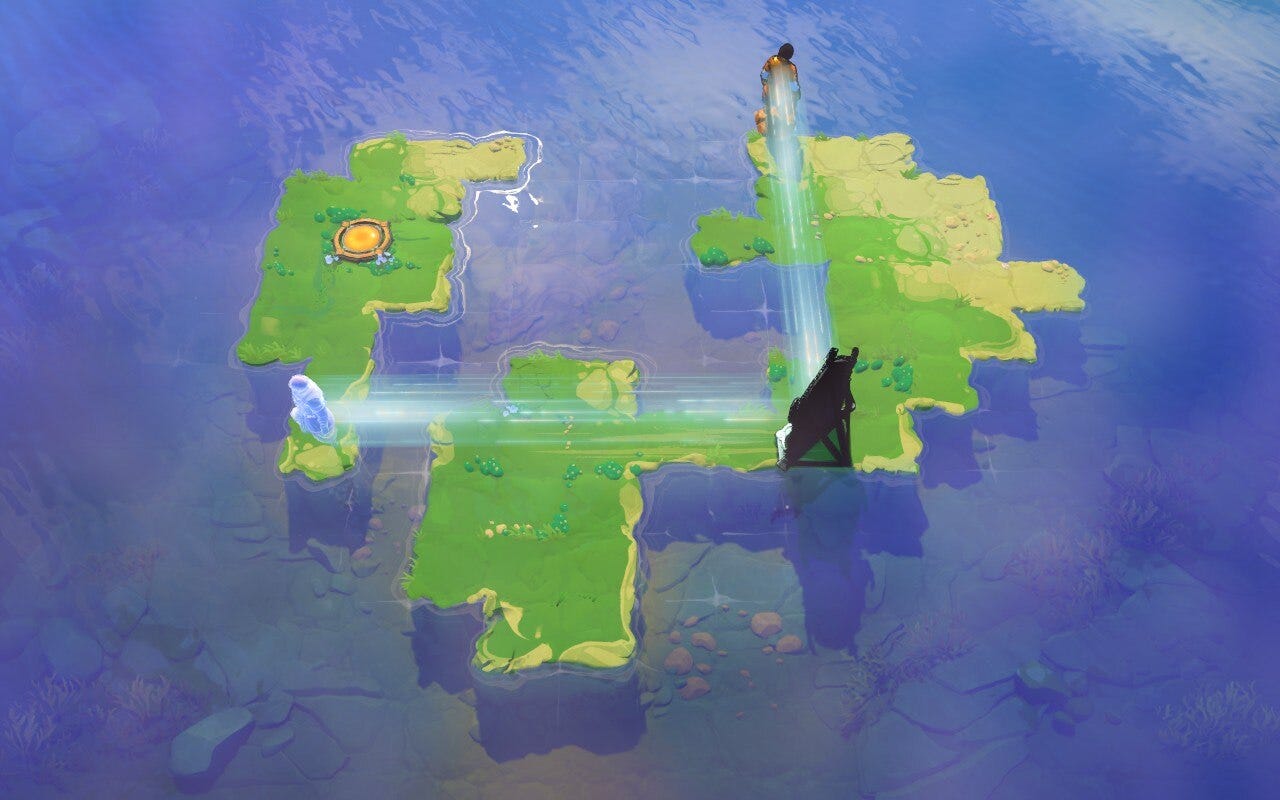
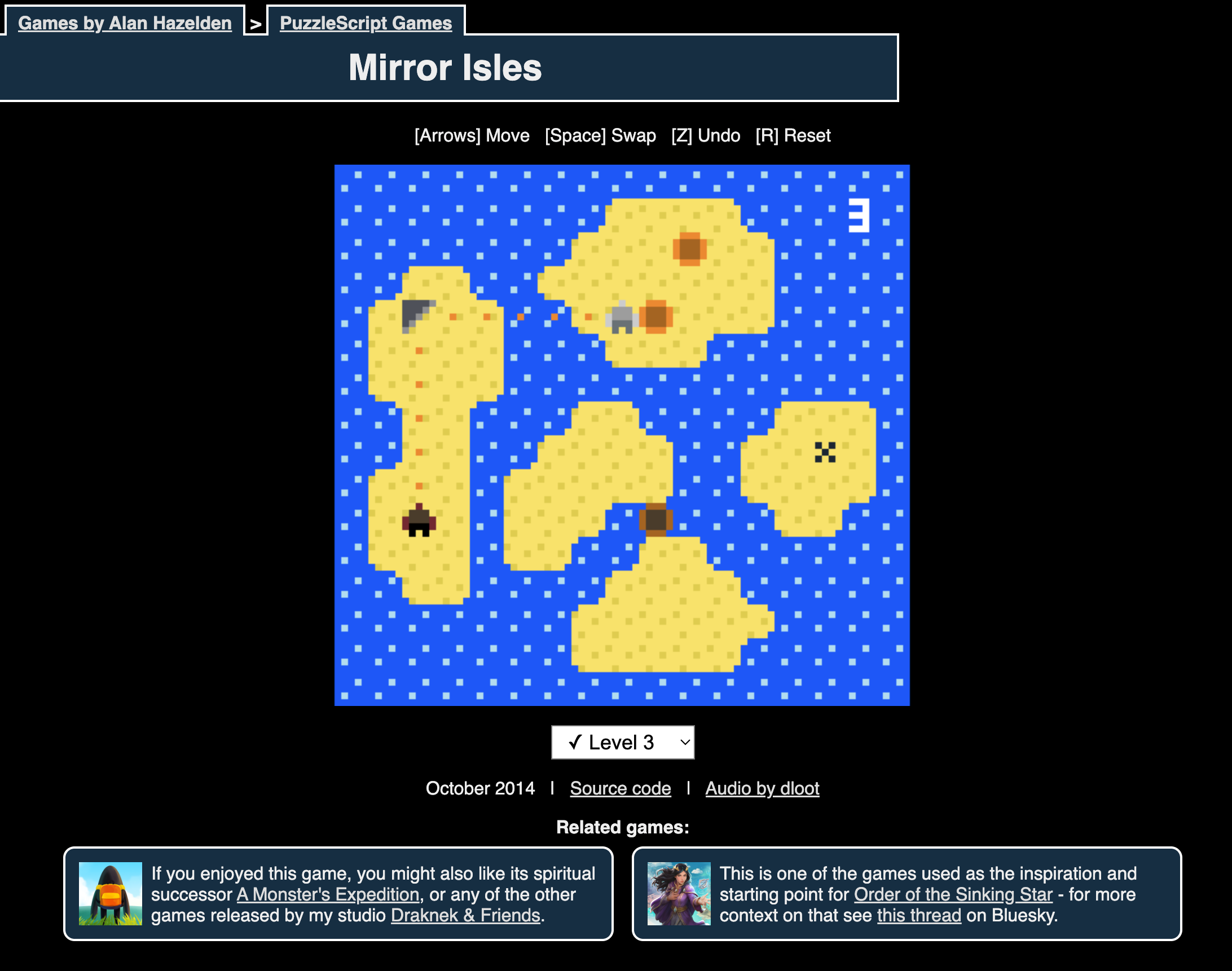
I was impressed with what I played. The Mirror Isles levels were challenging but fun. I learned how I could position my character on one small island, several squares below a mirror angled at 45 degrees. I could then teleport to a spot on another island, where the mirror was reflecting. I later tried Hazelden’s original, playable in a browser, and had a terrific time with it, too.
I ventured to Sinking Star’s north, where I was playing Hearty Heroes of Hauling, Thekla’s variation of Jonah Ostroff’s Heroes of Sokoban. I learned how a Warrior character could push blocks and how a Thief could drag them. A Wizard was able to swap places with the blocks. Some of these puzzles were tough, too, but also delightful to solve. I felt the most stress from a room that placed me as the Wizard amid a crowd of eight big crystal blocks. Through a lot of trial and error, I successfully found my way out.
Not long after I saw “Instigator: Hazelden, A” on the screen, I looked up. I’d been sitting in a chair situated at one end of the demo area’s coffee table. Other people had sat on the couch near the table. And, in the chair across from me, Blow had taken a seat.
I said hello and apologized for not yet publishing a write-up about his game, despite us having spoken about it back in December. Other stories had gotten in the way, but this hands-on would give me a new reason to get to it, I said.
Time to rewind
I have my own unusual history with Blow and the games he is known for.
In late 2008, while I worked at MTV News, the rapper Soulja Boy made a video laughing about how the Blow-developed time-bending puzzle game Braid was “stupid as hell.” That somehow led to me engaging in a video game battle with Soulja Boy in the MTV News offices in Times Square. (I beat him in Geometry Wars 2’s multiplayer mode; he beat me in Gears of War 2; he narrowly beat me in the world’s worst-played match of Street Fighter II).
In 2010, while I worked at Kotaku, I spotted an unattended demo station at the Penny Arcade Expo in Seattle. I saw Blow standing against a wall nearby, trying to not be noticed, and I realized the game in front of me was secretly his next project, The Witness. He wanted to see how people played it. I believe my coverage of that mysterious demo amounted to the game’s first press preview.
In 2023, while at Axios, I interviewed Blow about his post-Witness project, a remake of Braid. By that point, Blow had drawn controversy, not just from his occasionally cantankerous demeanor but from the ideas and politics he was expressing on social media. One batch of tweets from 2017 involved his belief that there were “biological factors” that played a role in what he believed were statistics showing women to be less interested than men in programming. Back in 2017 he took umbrage with backlash to his posts: “this constant insistence on suppressing speech is a big part of what turned me away from current ‘progressive’ politics.”
I’d seen Blow criticized for his statements, but could not recall seeing him questioned about them in interviews. So, six years after he’d made those tweets, I brought them up for the Axios piece. He didn’t sound happy about it, said he felt misunderstood. To the extent he wanted to address the topic, he told me this: “When we hire people, I very much believe in just hiring the best person for the job, because it’s just so hard to make games,” Blow told me at the time. “And we’ve hired quite a few women because they were the best people for the job.” He also told me he was trying to refrain from making a lot of non-gaming comments on social media.
Last December, Blow and I spoke about what his latest project was, this grand puzzle game with more than 1,400 puzzles, borne from a desire to create a new programming language. As he solved some of the game’s block-pushing puzzles over a video feed, we spoke of puzzle design. He talked about his team shaving the tedium out of the puzzles they were making for Order of the Sinking Star. He’d noticed they kept requiring a lot of busy work before players got to the fun part of the solution. “Now the set-ups are such that you’re really only a few moves away from doing the cool thing,” he said.
Meeting Patrick
I knew that playing Sinking Star in Nintendo’s booth in June meant it was likely I’d see Blow. As interested as I was in the game, I’d also need to ask him about what was happening around it.
So, at the distance of a coffee table, in the final minutes of Summer Game Fest, with, by that point I’d realized, at least one PR person for the game seated on the couch between us, I asked Blow if he wanted to talk about the pushback to the game. What did he have to say about these developers, upon whose work Order of the Sinking Star was built, all criticizing him and distancing themselves from the project?
Blow threw his head back, thinking about what to say. The silence was awkward. He gestured toward the PR rep nearby, told me they didn’t want him talking about it.
As Bloomberg noted in January, and as comes up in Reddit threads and other forum posts about the game, discussion around Order of the Sinking Star involves a perennial question about if, how or when to separate the art from the artist. More accurately, though, it’s about art and artists, plural.
Hazelden’s critique last December wasn’t simply about Blow’s politics but about the tendency to associate some games with a single creator:
“I hope the game will get a more nuanced label than ‘new Jon Blow game.’ While the creative vision is his, he didn’t make any of the original games and there are a lot of talented people at Thekla who also deserve credit.
“I was disappointed to see the store page description put his name front and center while not mentioning any of the creators of the original games. This industry’s obsession with auteurs is not healthy.”
Blow himself had not hidden the contributions of Hazelden and others from the game when we’d spoken in December. Press materials provided at the time named the other developers and their games. Blow had also told me about other esteemed game developers who were actively working with him on the game, including Patrick Traynor, the designer of a wonderful, recursive puzzle game called Patrick’s Parabox, which came out on Steam in 2022.
But a look at, say, Order of the Sinking Star’s Steam page shows a game listed as coming from Thekla, the studio Blow runs, and promoted as a Blow creation:
“From legendary director Jonathan Blow (Braid, The Witness) comes Order of the Sinking Star, a massive puzzle adventure featuring more than one thousand hand-crafted puzzles designed to put your intellect to the test.”2
After Blow’s no-comment on the controversy, and to cut some of the tension, I remarked that I had struggled with that puzzle room involving the teleporting Wizard and the crowd of eight big crystals.
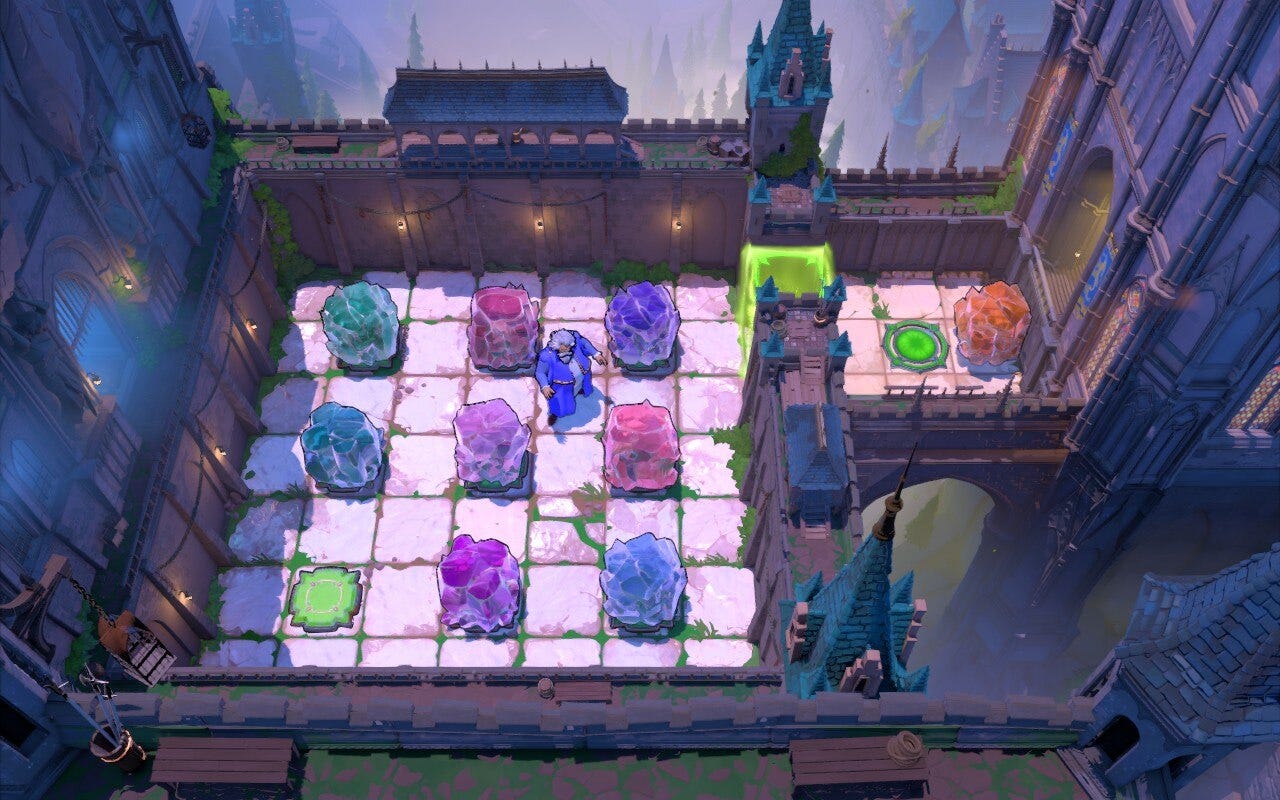
But you did it, enthused one of the men who’d sat down on the couch near me. I didn’t recognize him, and I asked if he’d worked on the game. He had. He’d worked on the very puzzle I was talking about. What was his name? Patrick, he said.
The lightbulb went on. Blow wasn’t the only top puzzle game designer sitting near me.
This was Patrick Traynor, the Patrick of Patrick’s Parabox, sitting feet away as I’d played some of his portion of the game. I’d nearly not known.
The text disappears
Shortly after I played Order of the Sinking Star in early June, Thekla released a PC demo. Many players were impressed, excited about the nuances of the puzzles and the obvious depth of the project.
On the 16th of June, one player started a discussion thread on the game’s Steam forums. They liked the game, they said, and they had a request: “Blow, please credit the original games and creators!” Blow did not reply, but other players did. They discussed the relevance and virtues of crediting the source games’ creators and the likelihood of bringing attention to those developers’ criticisms of Blow. Some mentioned that, in video streams, Blow has named the source games and even played parts of them.
Downloading the demo to my Steam Deck, I once again walked the queen to the Mirror Isles, where I’d solved puzzles on the pre-release Switch version two weeks before. I made the Queen approach the slab that had produced the words “Instigator: Hazelden, A,” but this time they did not. Instead, a large red square with symbols on it appeared. It was some sort of puzzle, kind of a vague map of the game’s overworld, I thought. It didn’t seem to be a game credit.
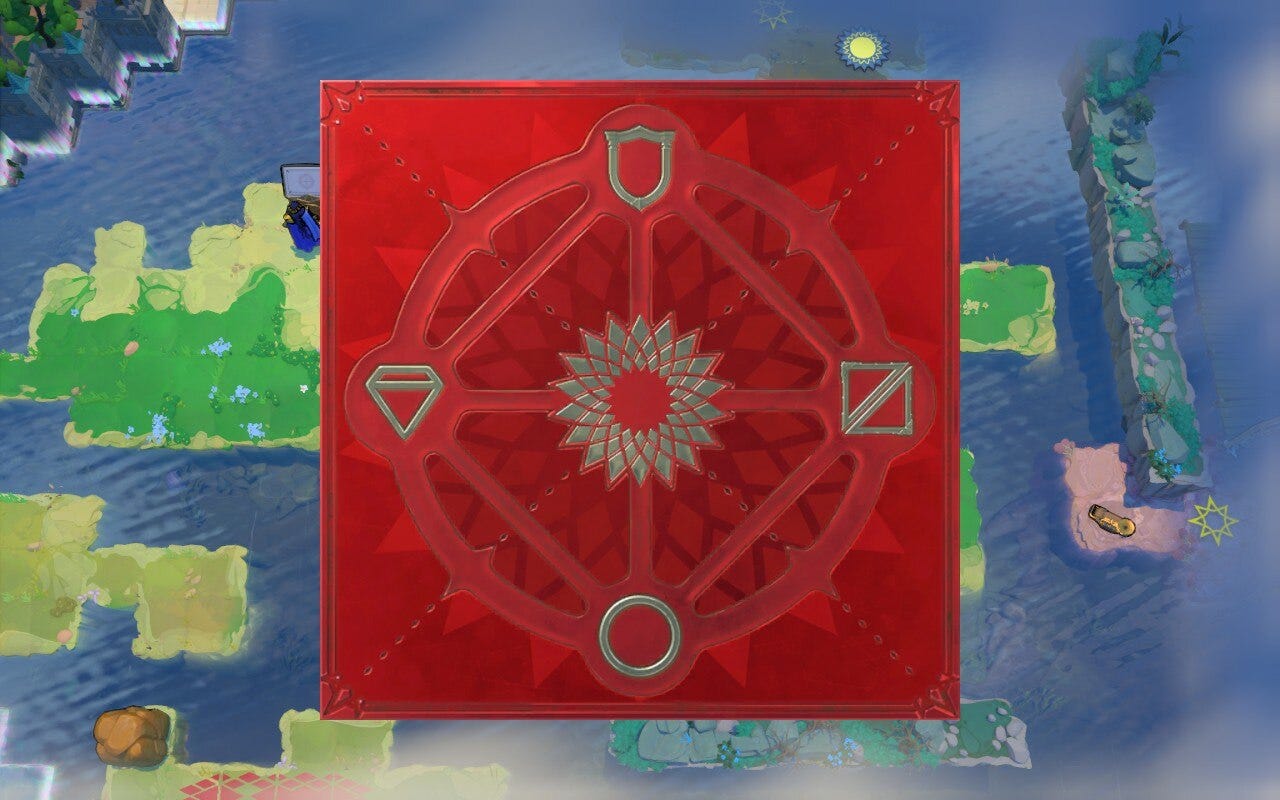
This week, I contacted Hazelden and asked about the credits. He said that his thread back in December was never about getting credit.
“My intent with that thread was to talk about how the game is discussed and viewed by its audience, not how my work is or isn’t acknowledged,” he said. “When I wrote my statement, my understanding was that the authors of the original games would be credited in-game at the start of each corresponding section, which I appreciated and considered to be appropriate.”
But he expressed disappointment with how credits were handled in the demo and was aware, before I’d mentioned it, that an earlier build of the game had had more prominent credits. “I’ve communicated with the Thekla team since they released the demo to let them know my expectations.”
Hazelden was concerned that the credits would now not appear until a player completed the game, rather than accessible at least from the main menu, which has become more of an industry standard. But he has seen one change he considers positive.
“Since I raised my concerns earlier this month, the website has been updated to include an FAQ entry which mentions the original games,” he said. That new portion of the website update says Sinking Star’s foundation “is built upon four brilliant titles,” links to them and names their developers, along with those such as Traynor who are making the new game.
I reached out to the Sinking Star’s PR reps about all of this earlier this week, noting that the “instigator” credit for Hazelden that I’d seen in the Switch version didn’t appear in the PC demo. Could they share anything about how credits would be handled in the final game?
They replied with a statement from Blow: “Contributors to the game will be credited.”
The thread was posted to what was then Hazelden’s personal account on BlueSky. That account has since been rebranded as the official feed for his puzzle-making game studio, Draknek & Friends.
There’s certainly a marketing angle to associating one person with a game, faulty as it is. I can’t help but think of this all-time amazing sentence published by IGN in 2012, in an article in which the game designer Warren Spector is trying to explain that game development is a team effort:
“There’s a tendency among the press to attribute the creation of a game to a single person,” says Warren Spector, creator of Thief and Deus Ex.