

My kids interviewed PlayStation about MLB The Show
"How do you guys pick the cover athlete?" "Can you change the color of the ball?" "Do you play baseball?" "Does it take a long time to make the game?”

“Are we the first kids that you’ve interviewed?”
Last Monday, my nine-year old daughter was asking that question as she and her twin brother spoke via video conference to Ramone Russell, the long-time director of product communications for Sony PlayStation’s baseball series MLB The Show.
Technically she and her brother were the ones doing the interviewing. Russell was being a good sport and answering them. He had agreed to chat with my kids about next week’s new multi-console release MLB The Show 26.
“Yes, y’all are the first,” Russell said. “And I’ve been working here a very long time,”
I’d recently asked PlayStation PR if they’d be up for a kid-driven interview about their new baseball game. My baseball-obsessed son loves MLB The Show and, I figured, would have better questions about the game than I would.
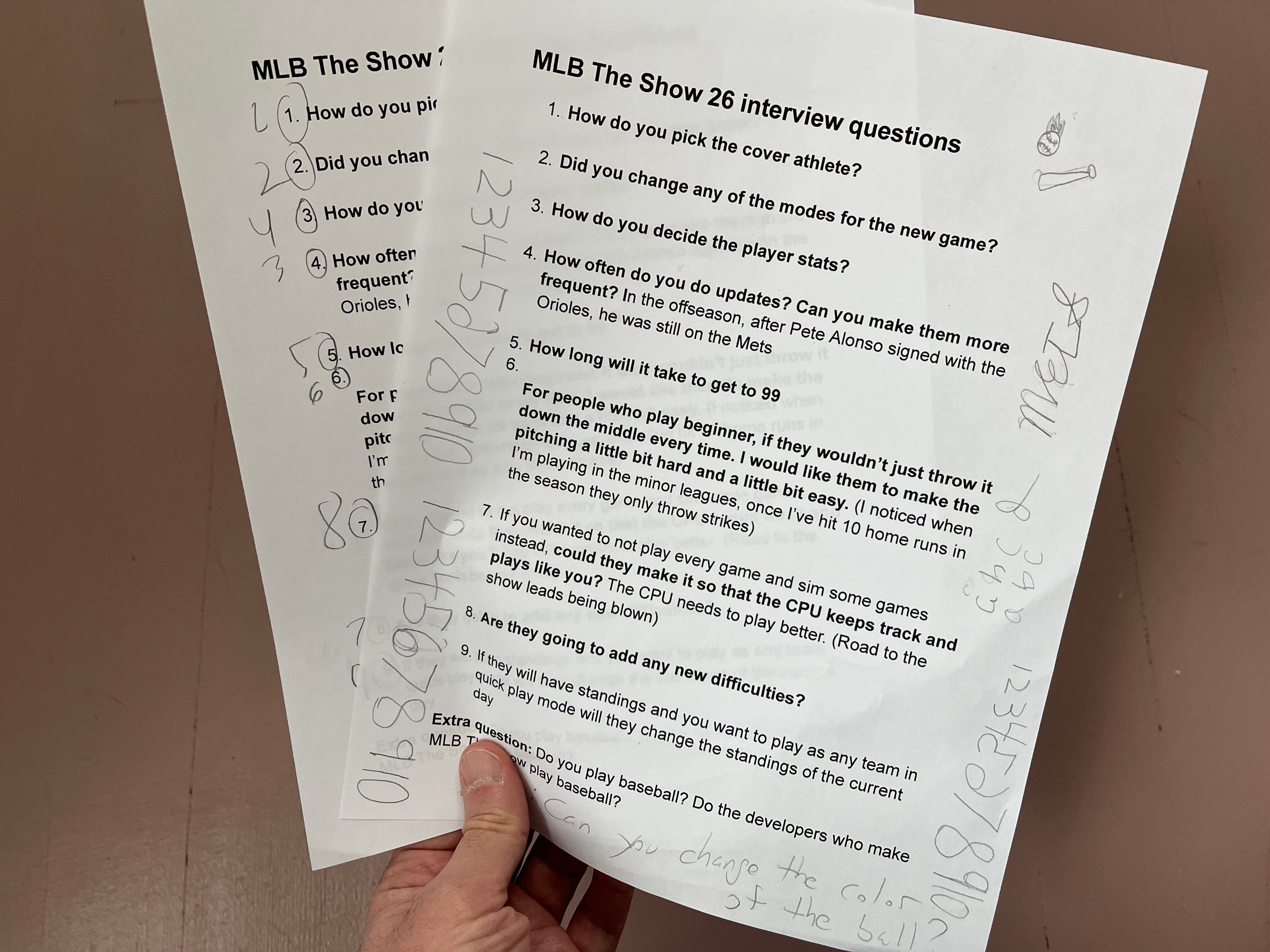
PR said yes, and my son spent a chunk of the preceding week getting pretty excited. A few days prior to the interview, he dictated some questions for me to print. On the day of the interview, he was locked in—totally fine skipping his after-school cupcake-making class so that he could talk to one of the makers of his favorite sports video game (Sorry, Drag x Drive, you’re second).
At first, his sister wasn’t as into the planned interview. She’s not an MLB The Show player. I promised her I’d try to book an interview for a game she’s into, too.
But they’re twins, and I know how this one would actually go. When I dropped them off last Monday for another daily helping of third grade, she clarified that she would be fine skipping her after-school activities as well. She would have questions for the interview, though she didn’t yet know what they would be.
By interview time on Monday afternoon, my kids1 were home, munching on fruit strips. My daughter declared that she’d like to ask half the questions on our printed list. Plus, she had an extra question of her own that I wrote at the bottom of her sheet.
Ramone Russell was cheerful when we all connected via video conference for the interview. Russell was calling from his office, sitting in front of shelves of baseball paraphernalia. He had framed copies of past editions of MLB The Show. He had trophies. Even some official The Show sneakers.
He asked them both how much MLB The Show they’ve played. My son replied: “One hundred and fifty hours.”
“Oh wow,” he said. “Thank you so much for playing our game so much.” He said he hoped it was interspersed with “lots of homework and reading as well.”
Russell asked my daughter how much she played. “Zero!” she replied.
He said he was pleased that at least half of his interview panel was into the game.

“How do you guys pick the cover athlete?” my son asked, when we got past the small talk and into the interview proper. “Do you just pick, like an MVP?”
“Yeah, that's kind of how it works,” Russell said. “So, you know, every year of baseball is different, right? Like, every year there's a new story. And so, what we try to do is, we always try to focus on, ‘Okay, who has one of the most interesting stories of last year?’ And if they win a bunch of awards, that's great. It's an added bonus, but it can't just be who wins all the awards, right? There's some other things that go into it. So, we always look at who's a good ambassador to help grow the game of baseball.”
He explained that the people making The Show want to be sure the series’ cover stars, like MLB The Show 26’s New York Yankee Aaron Judge, are “human beings that have a good track record of helping out.
Russell did not speak to my kids about marketability, which I appreciated. He kept it wholesome. Frankly, he was going to have a hard enough time convincing my Mets-loving/suffering son that a Yankee should even be on the cover this year.
“We look at the charities that they do. We look at the things that they care about off the field, and all those things get weighed and then a bunch of us get in the road. And we have what we call professional arguments to decide who’s going to be on the cover.”
I thought my son was about to lobby for one of his favorite New York Mets, maybe Juan Soto, now that his old favorite, Pete Alonso, recently became a Baltimore Oriole.
“I would’ve kind of argued for Cal Raleigh,” my son said, referring to the Seattle Mariners’ all-star catcher.
“He still has a shot,” Russell said. Maybe in a future MLB The Show game.

My daughter wanted to ask the next question. We were keeping it even, remember:
She asked: “Did you change any of the modes for the new game?”
“We changed all of the modes for the game,” Russell said.
“Oh!” my son replied. I think that impressed him.
Russell wanted to elaborate. “Do y’all have a favorite cartoon or movie or film that you like?” he asked.
My daughter was stumbling on an answer. I helped her out. She likes to watch Titanic, I said.
“So, we have to make, like Titanic 2 and Titanic 3 and Titanic 4, every single year,” Russell said. “What we want to do is make sure that your brother has a fantastic time playing the game, and he wants his dad to purchase it again next year. So, to answer your question: We work on every single mode to add things to those modes to hopefully entice our fans to be like, ‘Mom and dad, you have to buy me MLB The Show 26 because they added all these features that I care about that I want!’”
“What modes did you change the biggest, and how did you change them?” my son asked.
Road to the Show got the most changes, Russell said, “because it’s our most-played mode.” This mode lets players create their own player and steer their career into the Major Leagues and, ideally, to the World Series.
“This year, we're adding more colleges, and we're trying to focus on how can we showcase you getting into Cooperstown and officially getting inducted into the Hall of Fame,” Russell said. “You'll get these objectives—kind of like schoolwork—where you'll say, ‘Hey, I need to do X, Y, and Z over the course of my career, and it increases my chance to get into the Hall of Fame.’”
My son wanted to know if they added any new modes to The Show 26.
No new modes, Russell said, but the new game does let you play in the virtual version of the World Baseball Classic, the international tournament that’s happening right now in the real world.
My son had a technical question about how often MLB The Show’s rosters are updated. He explained that MLB The Show 25 still had his longtime favorite, Pete Alonso, on the Mets this past fall, even after Alonso signed with the Baltimore Orioles.
Russell explained that the off-season player movements would be reflected in this year’s game.
“It’s my turn,” my daughter said. She looked over the list of questions. I reminded her that we’d written down a special one that she thought up earlier in the day.
“Can you change the color of the ball?” she asked.
Russell laughed.
“No, unfortunately, we can’t,” he said. “That's a Major League Baseball rule, because, if we change the color of the ball, you may give the batters an advantage and the pitchers a disadvantage.”
Russell picked up a baseball to show my daughter what he meant. He explained how the stitching has to be a certain way, how changes to the ball could make things unfair. It was a good answer and I thought we were about to move on.
Nope.
“In the Home Run Derby in real life, they usually have, during the bonus time, pink and black balls,” my son said. (I did not know this! But he was right about the pink balls.) “Do you guys have those in the game?”
He’d thrown Russell a curve.
“I don't think we do yet,” Russell said, “Because for us to change the way that the color of the ball looks in game, it's a lot of work, just for the Home Run Derby.”
I asked Russell if that’s the first time he was asked about the color of the ball. He confirmed it was. I cheered my daughter on. So proud!
New question, as my son got increasingly hardcore with his queries: “How long will it take to get to 99 overall in the Road to the Show?”
“How long did it take you last year, do you remember?” Russell asked.
“I didn't get all the way through,” my son replied. “I got into the 80s but not to the 90s.”
(For non-Show readers, you increase your player’s stats throughout their fictional MLB career.)
“It should be a little bit faster this year because we're allowing you to set more goals and more achievements,” Russell said. “As you hit those, you'll get more points to spend on your player to get to 99 faster, so a little faster than last year.”
“There’s one question that ties to it,” my son said. He was asking a follow-up!
He started asking about how the computer pitches to you when you’re playing Road to the Show on beginner mode. In MLB The Show 25, the pitches are thrown down the middle of the plate, making them pretty easy to hit. He was wondering if the virtual pitcher could sometimes aim for the corner of the strike zone, maybe a little outside.
“You want beginner mode to be harder?” Russell asked.
“Yeah, just a little bit,” my son replied.
Russell suggested he try the game’s dynamic difficulty mode, which would adjust to his skill level. “It'll start throwing things down the middle, but as your batting average gets higher and as you get better, it'll start throwing more in the corner.”
My daughter’s turn, asking the lone question I wrote for them: “Do you play baseball, or do the developers who make MLB The Show play baseball?”
“I personally did not, but I would say, at least 10 or 15 of the other developers… still play baseball on weekends,” he said.
My son was up: He noted that you can “sim” games during the virtual baseball season that you play through in The Show. That means the computer can play portions of games or entire games for you. But, he said, the CPU in MLB The Show 25 didn’t always play as well as he did. "Could they make the CPU keep track of how you play?” he asked. “When I’ve been playing in Road to the Show, I've seen that the lead kind of gets blown a lot on me. So if we we’re winning, like, five to three, then when I'm [back] up to bat, it's like seven to five or eight to five.”
“I'm so happy you asked that question,” Russell said, “Because, this year, we have a new feature that does just that.” The CPU is smarter and, when it is asked to take over, he said, it will play more like the human being who was otherwise in control of that player and team.
Russell said this was something they’d received a lot of feedback about. The developers run surveys and try to listen to players, he said. “We track all of this feedback, and, then if we're really good at our jobs, we're able to create new features that help fix issues or improve the game.”
“One more question,” my son said. “How do you decide the player’s stats?” He was talking about the game’s ratings for all of its real-life MLB players.
“We look at a three year average,” Russell said. “We looked at three total years, because you know baseball is a really hard sport, right? You can have one good year and then the next year have a bad year. And so, to make sure we don’t overrate or underrate players, we look in the past three years and we averaged them out. That’s where the player ratings start out at the beginning of the year. But, as the year keeps going on and players keep playing, we then focus more on what people are doing right now.”
I asked my son if he thought the players in MLB The Show 25 had the right stats.
He brought up Pete Alonso, to my total lack of surprise. “I just thought that he should not be kind of in the 80s,” he said. “I thought maybe 90, like maybe 90-91?”
“You wanted more power?” Russell asked? “More contact?” We were talking a couple of days before The Show 26’s player ratings would be revealed. For this year’s game, Alonso is rated 85.
At this point, my daughter was starting to get distracted. Lots of doodling and fidgeting. Totally understandable. She's not sweating the player ratings in the game.
My son wanted to know if there were any new difficulty levels in this year’s game.
No, Russell said, but he was excited about a new option for batting controls called Big Zone Hitting. He asked my son which hitting controls he used.
“I've been using the zone thing where you move the other stick to, like match the ball,” he said.
“Is that hard or have you figured it out?” Russell asked.
“It’s easy for me,” my son replied.
“It's easy for you. Oh my god, that's incredible!” Russell said. “That's like the hardest way to play. You found it easy. Good for you.” He and my son then chatted about the new Big Zone Hitting controls. At this point I had no idea what they were talking about, but Russell and my kid seemed to get it, so all good.
My son then had a question about the MLB team standings that are shown when you play a quick one-off game of baseball in The Show. On any given day, you can play a virtual game between two teams, but could the developers make it so that the teams are in the same place in their division in the game as their real life counterparts are at that point in the season? “If you're playing quick mode and you jump into the game, will it have the actual standings [from] before that game?” he asked.
“Oh, the actual standings from real life,” Russell said. “No, it'll be like it was last year.”
“I don’t even understand that one,” I said.
Didn’t matter, because Russell seemed to. He was writing it down. “That's actually a good idea,” he said. “That's a really good idea!”
“Hey, he's taking a note!” I exclaimed to my son. “Maybe you'll have an influence on MLB The Show 27.” I paused. “We assume they're making one,” I told the kids, “but they can't say if they're making it.”
“They are!” my daughter said.
We moved on…
“Does it take a long time to make the game?” my son asked.
“Oh yeah, it's a lot of hard work,” Russell said. “It takes us every single second that we have throughout the development cycle to make the game. Yes, 100%, it's lot of work.
“How many people make the game?” my daughter asked.
“I can’t give out the total number, but it’s a lot,” Russell said.
I noted that it was probably more than 100 people.
“Oh yeah, it's definitely more than a hundred. You can say that.”
I let my kids know that we were out of time. I commended them for asking good questions and getting good answers. Did Russell have any questions for them?
“How was I at answering your questions?” he asked.
My son said Russell “did a good job.”
“On a scale of one to ten, how good was he at answering questions?” I asked, egging them on.
“Hmm,” my daughter pondered. “A seven!”
My son laughed, then said, “Nine point nine!”
Item 2: In brief…
🪠 Nintendo of America is suing the United States government in the Court of International Trade over Donald Trump’s 2025 tariffs, joining scores of other companies that have filed lawsuits since the Supreme Court ruled the levies illegal on February 22. Aftermath had the scoop.
“Plaintiff has been directly harmed by Defendants’ unlawful actions,” Nintendo says in its complaint, which names U.S. Treasury Secretary Scott Bessent, recently-demoted Homeland Security chief Kristi Noem, and Commerce Secretary Howard Lutnick among its defendants.
Nintendo increased prices of the original Switch as well as Switch 2 accessories following the April 2025 implementation of higher tariffs on goods from China and Vietnam, where much of Nintendo’s physical products are manufactured.
It is now seeking refunds, with interest, or other monetary damages, via the suit.
Other companies that have sued over the tariffs include FedEx, Costco and Revlon. The AP reported in late February that more than 1,000 firms have sued, many prior to the Supreme Court’s ruling.
In February, FedEx said it would pass on any refunds to consumers. I asked a rep for Nintendo of America about the lawsuit and if they planned to also refund consumers, should they win relief. Their reply: “We can confirm that we filed a request. We have nothing else to share on this topic.”
🧬 Project Helix is the codename for Microsoft’s next generation console, new Xbox CEO Asha Sharma announced on Twitter/X on Thursday.
“Project Helix will lead in performance and play your Xbox and PC games,” she wrote.
The cross-compatibility news was consistent with other Microsoft moves that blur the line between Xbox gaming and PC gaming: 1) the pledge from Xbox’s prior leadership pledge last year to “ensure that Windows is the number one platform for gaming” and 2) the late-2025 release of an Xbox-branded handheld that plays PC games via the Steam and Xbox PC marketplaces.
Microsoft’s VP of its next gen Xbox, Jason Ronald, is giving a talk at GDC this coming week, titled “Building for the Future With Xbox” (Description: “Join us for a conversation about the vision shaping the future of Xbox and how we’re building a more flexible, connected future for game creators and players everywhere.”)
⚔️ Slay the Spire II is Steam’s latest indie-developed smash hit. Mega Crit Games’ turn-based card-combat sequel drew over 500,000 concurrent players on Saturday, during its first weekend of early access release.
Item 3: The week ahead
Monday, March 9
The GDC Festival of Gaming (formerly the Game Developers Conference) kicks off in San Francisco, offering a week of in-person talks about game development (and one panel about independent games journalism, featuring a reporter you might recognize).
Thursday, March 12
Fatal Frame II: Crimson Butterfly Remake (PC, console) and John Carpenter’s Toxic Commando (PC, PlayStation, Xbox) are released.
Friday, March 13
Monster Hunter Stories 3: Twisted Reflection (PC, console) is released.
As longtime Game File readers know, I don’t use my kids’ names when I write about them. I considered giving them special monikers for this article. Maybe Game Boy and Game Girl or File Boy and File Girl? But I couldn’t figure out a pairing I liked.
Your kids did a great job. When you play an exhibition game on the day of a “real” game I also wondered why they can’t incorporate real time data in it. Great minds….
Also, re:Nintendo, when they get all the tariffs back those will be refunded to the consumer that paid a higher price, right?? lol I know the answer…
Great idea for the interview. Have zero interest in baseball, but read it anyway thanks to the original and engaging format!