


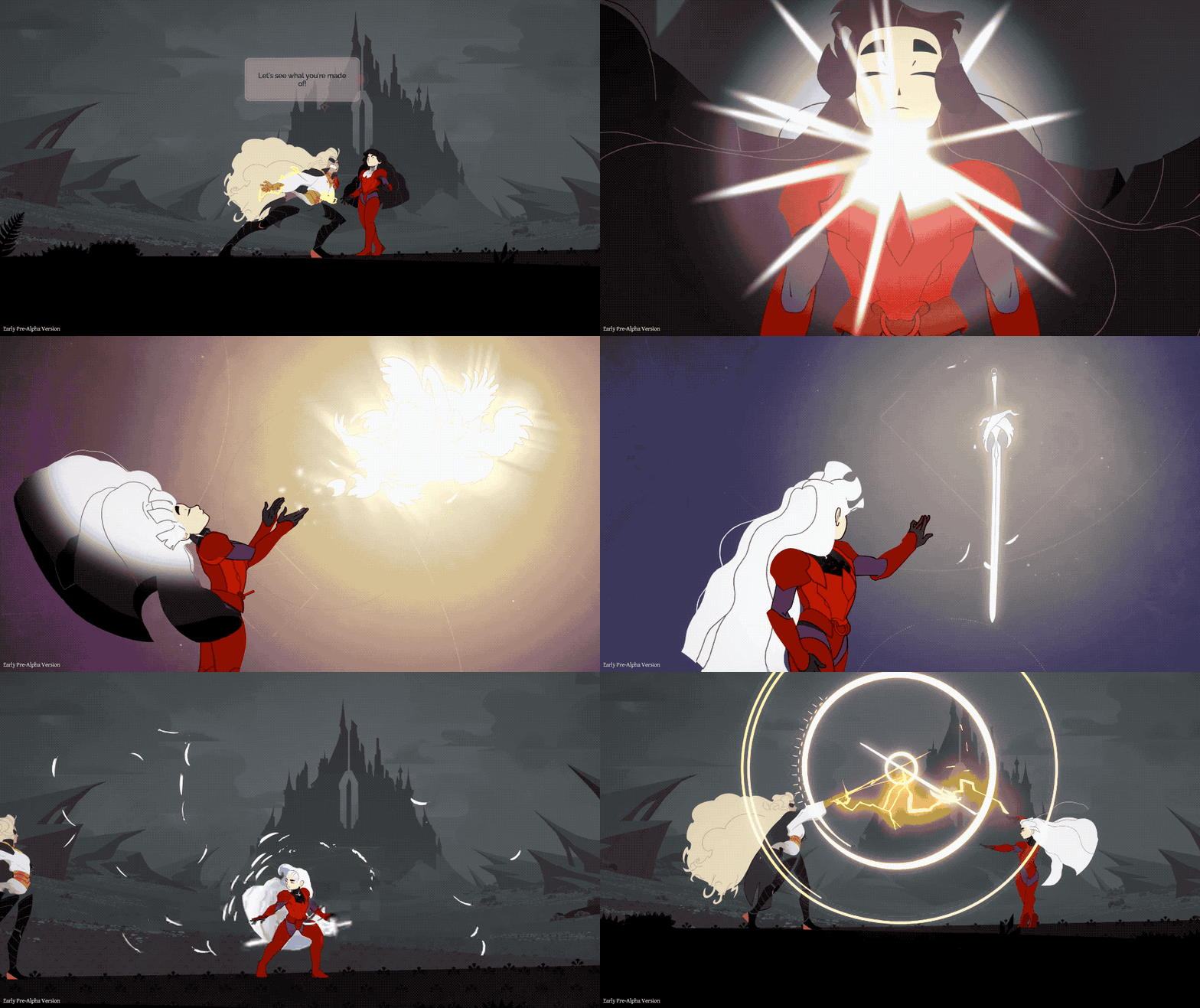
More upcoming games keep grabbing my attention. Among them, At Fate’s End, a violent family drama from Thunder Lotus slated for later this year.
“In At Fates End, you have to fight the people you love,” the game’s creative director, Nicolas Guérin, told me at a game showcase in San Francisco last month.
I was at the controls of the beautifully animated 2D fantasy game, directing protagonist Shan Hemlock through the game’s opening moments. Shan has returned to her home kingdom, encountering big sister Camilla outside a castle. Their mother had recently died, but before her death, mom told Shan that she would be the Princess of Swords. That’s a title given to someone who must gather precious, magical swords from each family member in a process called The Gathering. Each sword had claimed a part of its wielder and imbued them with special powers. Camilla’s weapon took her left arm; Shan’s her throat.
“Full disclaimer, those guys on the screen are pretty much assholes,” Guérin said, as the sisters face off. “All of them, including you. Because they’re rich, because they’re powerful, because they’ve been in a family that ruled the world for millennia.”
Guérin’s previous project at Montreal-baed Thunder Lotus was 2020’s Spiritfarer, a beautiful game about escorting people into the afterlife. It was a game about death, basically. This one’s about families and the failures of a fantasy world’s ruling class. “I’m French, I love history and I can tell you that knights and aristocracy have not been a good thing,” Guérin said.
Gameplay mixes crunchy 2D sword combat with side-scrolling investigation. Shan needs to get her family member’s swords, through combat or perhaps by talking things through, based on what she’s able to learn.
In the demo, Shan lost her first duel with her sister, then explored the castle grounds observing and logging clues. Collected information is displayed as cards that fill out an investigation board. Tarot cards are a heavy creative influence, as Shan acquires powers rendered as cards which bequeath different abilities depending on their orientation.
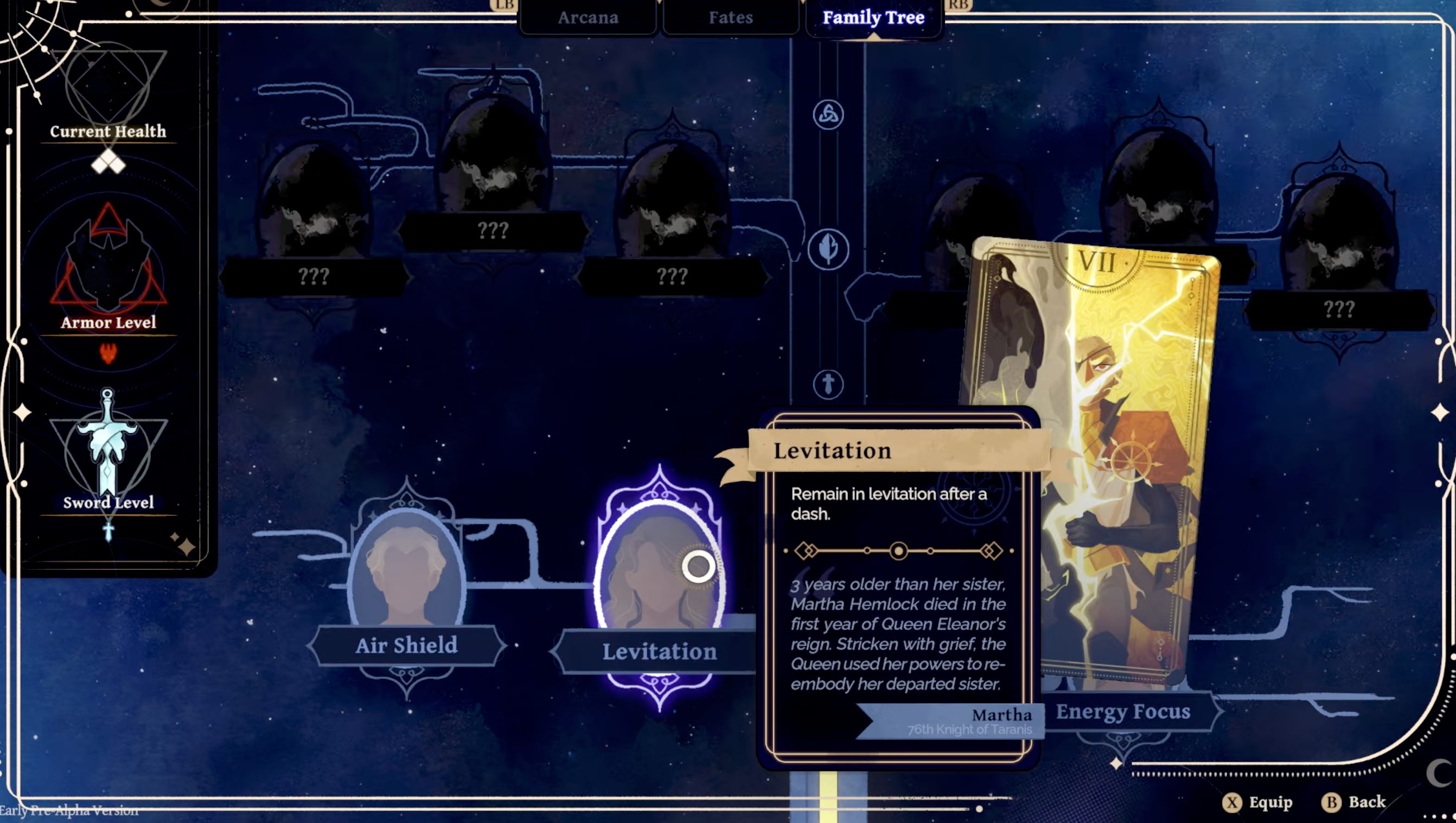
One of the game’s most intriguing touches is its skill tree (see above). Players navigate the skill tree to unlock abilities for Shan, but the branches double as a family tree, with each skill node representing a member of Shan’s ancestral lineage. Guérin promised that the family history that is revealed through unlocking skills is “super flawed and fucked up.”
Sold!
Guérin and team are hoping to ship At Fate’s End later this year, on PC, PlayStation and Xbox.
Blighted is a top-down action game from Toronto-based Drinkbox Studios, in which you’re collecting memories by eating brains. It comes off as more heroic than it sounds. The game is set in a colorful, rugged fantasy world in which people are buried with a seed in their head, with the seeds sprouting trees whose fruits contain their memories. A villain has destroyed the memory forest, but defeating bosses in the game lets you eat their brains, which will alter your character.
Skillful play in Blighted changes the game in real-time. As you succeed in combat, you’re filling a “frenzy” meter, increasing its numerical level and strengthening both yourself and you enemies. Higher levels trigger traps in the world and expose players to new enemy attacks that players would miss if they’re struggling. A higher frenzy level can also empower your own character and trigger special player abilities.
Drinkbox co-founder Graham Smith told me at showcase last month to expect a game that mixes Dark Souls combat and Metroidvania back-tracking exploration. An added inspiration is Tunic, a beloved 2022 action-adventure game that was packed with secrets that were hiding in plain sight.
I know Drinkbox’s work best from its older Guacamelee games, a pair of Metroidvanias from the 2010s. But Smith told me that the studio’s most recent game, 2022’s hero-transformation adventure Nobody Saves the World, was the biggest the reason that Drinkbox has been in good shape as a studio while making Blighted. “I think each of our games have helped us fund the next game,” he told me, noting that “Nobody Saves the World was our most financially successful game.” Smith estimates about 16 people are working on the Blighted full-time.
The new game is nearly done and currently playable from beginning to end, Smith said.
A high priority now is extensive play-testing, which Smith consideres a Drinkbox hallmark. “We probably do more play-testing than most other studios,” he said. For Nobody Saves the World, the team was conducting external playtests eight months before submitting the game for release, as one tester at a time played through the game over the course of a week. “Almost every week we had someone playing the game,” he said. “They’re streaming it over Discord. Our team is watching. We’re working and watching.” (Those Discord streams are private, of course!). The team would check to see where the player died a lot, why they sometimes spent two hours doing something the developers thought was doable in a half hour. The studio uses its testing to smooth out unnecessary friction, Smith said, while trying to retain some level of challenge: “Sometimes someone will die at a boss 50 times, but they’ll tell you, ‘I had fun.’ And you’re like, ‘Hmm, 50 seems too much.’”
Blighted is announced for PC and Switch, so far, releasing in the fall.
I will always take a meeting with 11 Bit, whose reps last month showed me the game they announced today: Crop. It’s externally developed by new Norwegian studio Carbonara Games and published by Warsaw-based 11 Bit.
It was back in 2014 when 11 Bit earned my trust, as they asked me to check out a very different kind of war game. This War Of Mine, shown on a small laptop at GDC that year, was about civilian survival during urban warfare. It was as un-glorious a war game as there’s ever been. This was a studio avoiding easy thrills, I noted.
Since then, I’ve been impressed with 11 Bit’s bleak sub-zero city survival game Frostpunk. Last year’s clone-management survival game The Alters was among my favorites.
At a hotel near this year’s GDC this year, 11 Bit was showing Crop, a dreary farming game in which your character wakes up naked in the trunk of a car, wanders to a wrecked farm, and starts planting crops under sunless skies. This is the kind of farming game that teaches you to dig holes in the ground by forcing you to dig a grave for the farm’s prior owner.
Gameplay in Crop is intentionally slow. You dig and plant and rake. Eventually you unlock irrigation. Slugs, rats and crows can bother your crops. Harvests of mushrooms and vegetables can be sold, but for less money if they’re “lousy.”
This is not a farming game where you’re dating the townsfolk, an 11 Bit rep told me. But there is a town, populated with strange people. Part of the game is detective work. How’d you get here? What’s up with all these weirdos?
Oh, and why was that car overflowing with blood?
11 Bit is busy, with some four games at various stages of internal development, including a reimagining of the original Frostpunk. Crop is among three externally published games slated for a 2027 launch. The company has published a batch of games of late. While many past and future have the bleak, meaningful narrative heft of 11 Bit’s signature work, company reps point to Crop as an example of a renewed emphasis on mechanically satisfying gameplay, too.
I’m just wondering if one of the mechanics for Crop is going to involve watering crops with your character’s blood. There were hints, if not confirmation.
A global mix of games
Today’s write-ups cover two Canadian-developed games and a Norwegian game published by a Polish game company.
That’s not by design. It’s just the wonderfully international nature of the video game industry.
Consider this: I saw one of the above games, Blighted, at an indie showcase hosted by Nintendo. The Switch-maker had rented a demo room in a hotel in San Francisco and secured several studios to show their Switch/Switch 2 games. As I checked the games at that Nintendo, I was struck by how international the room was: Blighted hailed from Canada; a peaceful puzzle-platformer called Hoa 2 was made in Vietnam; an octopus side-scroller called Darwin’s Paradox was developed in France; a black-and-white cartoony first-person shooter called Mouse: P.I. For Hire was crafted in Poland. Elden Ring was there, too, so that’s Japan. And Mina the Hollower, the promising next game from the makers of Shovel Knight, essentially repped the U.S.
The spread of talent and creativity from around the world is one of my favorite things about video games.
I’m fully invested in all 3 of these! Thanks for covering them, which one’s your favourite?