

Xbox's reverse-2018
One of the biggest acquirers of game studios in the past decade prepares to contract (again).

Several weeks ago, while looking for an official source for some facts that I needed to cite, I found an official Xbox article with an awkward chart.
The article was published on January 18, 2022, bylined to Phil Spencer, then CEO of Microsoft Gaming.
The headline: Welcoming the Incredible Teams and Legendary Franchises of Activision Blizzard to Microsoft Gaming
Scrolling down a bit was the org chart, a stack of 13 headshots representing Xbox’s “Gaming Leadership Team.”

Four years later, nearly half of the people in that image, including Spencer and his seeming successor, Sarah Bond, are gone from the company.
An image of triumph is now the first in a Before/After set that signifies a radical reshaping one of the biggest gaming organizations in the industry. And not the kind of reshaping that the people in that image were hoping for.
You’d expect some churn among executives over the course of four years, of course.
But the last four years for Xbox have been anything but normal, with a record-setting $69 billion price paid for Activision Blizzard in 2023 and subsequent signs of intense organizational stress: layoffs, more layoffs, a studio closure, two console price hikes, a price hike on the crown jewel Xbox Game Pass service, a leadership team overhaul, a Game Pass price cut, a warning from new Xbox CEO Asha Sharma to her team about “hard choices,” the unusual public airing of the division’s slender 3% “accountability margin” (the Xbox group’s profit margin, basically) and, this week, reports from multiple outlets of at least three Microsoft game studios facing closure or, at best, some sort of spin-off into precarious independence.
As reported by Bloomberg on Monday, Compulsion Games (makers of Peabody-winning 2025 release South of Midnight), Double Fine (best known for Psychonauts), and Ninja Theory (Hellblade) are on their way out of the Xbox studio group, one way or the other. And “several” other Xbox teams are “at risk of being shuttered,” the outlet noted.
Microsoft has yet to comment.
The three studios are similar in that they’re on the artsier end of things.
Compulsion’s South of Midnight is a third-person action adventure about fighting supernatural creatures in the deep south, set to an experimentally piecemeal soundtrack that builds with the action in each level.
Double Fine just released a multiplayer fighting game called Kiln, in which each player’s character is a piece of pottery; before that, a game featuring a lighthouse that can walk.
Ninja Theory’s Hellblade games are about a swordswoman dealing with the whispers in her mind (Two years ago, I wrestled with what to make of the series’ strange and slight second game; it ultimately won me over)
Those are all interesting games that fit into a long-running paradigm for console-makers: they typically have the teams that make blockbusters alongside those that make the weirder stuff. Sometimes the niche stuff breaks out, sometimes wins awards, sometimes just helps round out the portfolio and allow executives to say that they don’t just finance products but art, too.
None of the most recent games from the endangered studios appears to have been a commercial hit, based on the limited data publicly available.
Even more opaque is how those games did or didn’t fit into Xbox’s long-running Game Pass strategy, which under Spencer, involved packing the subscription service with new content. You buy studios to make games to stock the release queue to keep subscribers playing and paying. That’s the theory.
A different era
The three studios facing a closure or crossroads were all added to Microsoft during a flurry of expansion.
At E3 in June 2018, Spencer announced the acquisition of four game studios—Undead Labs, Playground Games, Ninja Theory and Compulsion—plus the creation of the since-shuttered The Initiative.
The company framed this as Xbox “investing in development of original content,” of “doubling” its game studios.
Later that year, Microsoft announced the purchase of two more studios, Obsidian and InXile.
The purchase of Double Fine was announced in 2019.
Microsoft kept buying: the vast ZeniMax game group (Bethesda, id, Arkane, MachineGames, more) in 2021, Activision Blizzard in 2023.
It took a while for many of those studios—especially the smaller formerly indie ones in that first wave—to release brand-new games. A globally disruptive pandemic in 2020 certainly didn’t help anyone’s development cycle. Microsoft’s bulge of acquisitions preceded a boom in game releases by years. Only in the 2024 and 2025 did the output catch up.
“We want to make great games”
Two months ago, when I interviewed Xbox’s Asha Sharma, 60 days into the job, I asked if she had targets or a timeline for her division, especially given reporting of pressure in 2025 for the gaming team to hit 30% margins (margins she’d reveal last week to have been achieved at just 3%).
“The big things that we’re thinking about are we want to make great games,” Sharma said.
“Matt can talk about that,” she added, referring to longtime Xbox game studio chief Matt Booty, who was also sitting for the interview. She continued: “The Peabody Award for South of Midnight, Kiln coming out today. Like, I just feel like every day there’s something wonderful there.”
By Sharma’s 100th day, some of those studios whose work she cited would be in the aforementioned bind.
Most extraordinary, Ninja Theory even debuted a new game, a third Hellblade title called Senua, at the Xbox Game Showcase 2026 on June 7. By the time that game was revealed, Microsoft had already planned to sunset or split with the studio. The thinking was that the promise of a newly announced game would help draw investor interest in the studio, a source familiar with Microsoft’s plans told Game File (it’s unclear if anyone atop Ninja Theory was involved in this plan).
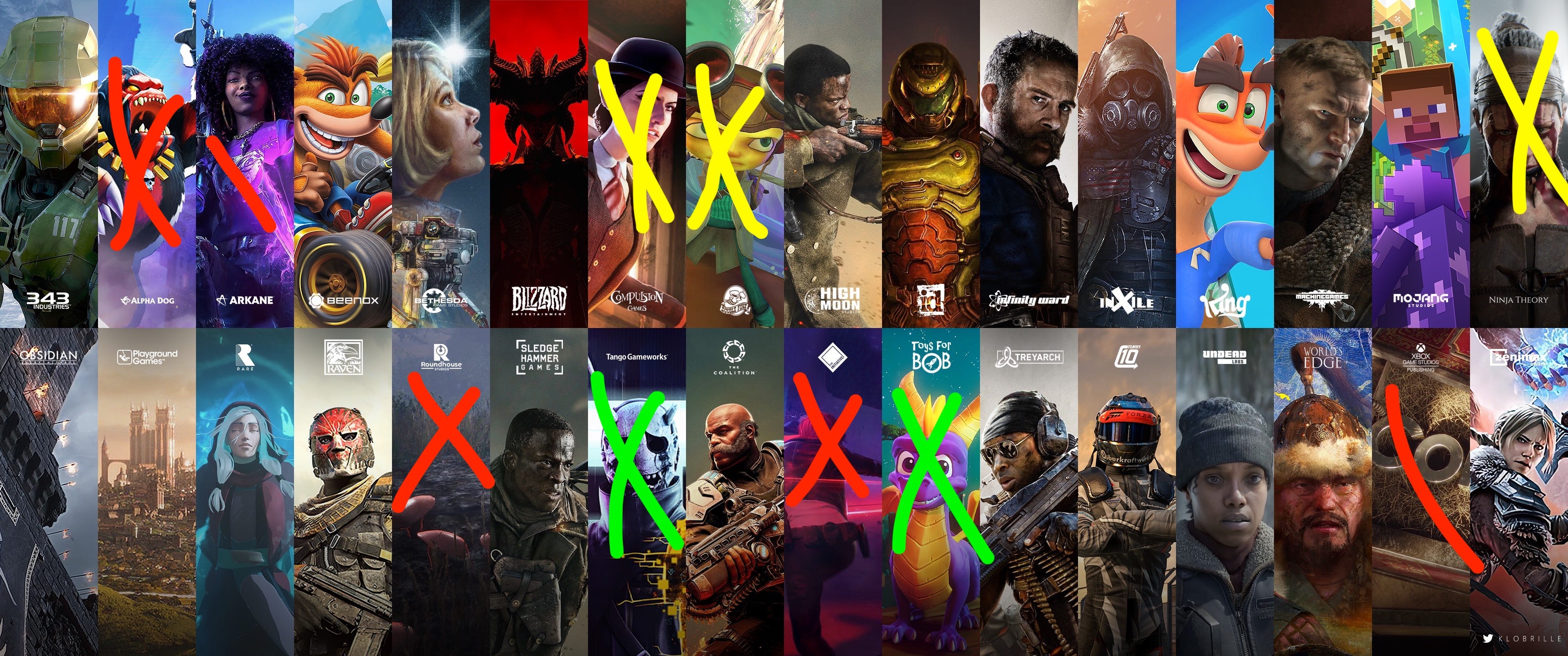
All of this drama around the studios and the workers likely to be impacted brought to my mind another chart, the one you can see atop the post.
The original version of it, without the mark-ups, was posted in 2022 by a Twitter/X user and Xbox super-fan who goes by Klobrille. The image depicted the massive network of studios Microsoft would own if its bid for Activision Blizzard went through.
That image became outdated quickly. In 2024, a Bethesda studio called Alpha Dog was closed. Another, Roundhouse, was absorbed into ZeniMax Online Studios. Tango Gameworks, an artsy studio behind the award-winning Hi-Fi Rush, was also shut down, though its employees and intellectual property were purchased and reconstituted by Krafton later that year.
Around the same time, in early 2024, Toys for Bob, long one of Activision’s tinier, quirkier studios, was able to spin off and go independent. They even got a publishing deal with Microsoft and showcased a new Spyro The Dragon game at the Xbox showcase earlier this month. In other words, they’re making another game for Microsoft, but the responsibility for running their business and surviving in a tumultuous industry is now their own.
Item 2: In brief…
🚫 Ubisoft said last week that it is shutting down its studios in Belgrade and Winnipeg, and restructuring its Barcelona studio, all of which could result in 380 eliminated jobs, Game Developer reports.
Ubisoft also cut more jobs in North Carolina and California (93 in San Francisco).
🎮 Award-winning French game studio Don’t Nod (Life is Strange, Jusant) could be out of money by November if it fails to find new funding, Games Industry reports.
🇫🇷 Nintendo has been fined €35 million by France over the original Switch’s notorious Joy-Con drift manufacturing defect, Le Monde reports.
🦇 And finally, a tiny item that isn’t depressing: The new Lego Batman game includes some blink-and-you’ll-miss-it programming code for the Commodore 64, which Panic’s Cabel Sasser discovered, runs a little Batman logo animation on a C64.
Hey Stephen,
In regards to MS's reasoning for announcing Senua despite knowing they will not actually release the game. I feel that section of your write up here lacks a bit of really important context. Can you elaborate/follow up on these questions:
- Did you ask Ninja Theory for comment/clarification how much they were involved in that move? And if yes, did the staff know? Since when? Did you reach out?
As for why it was done:
- Also Xbox did benefit from the announcement as it helped to present a strong brand for their comeback tour. The audience and engagement for the showcase was significantly bigger then for the later clusore news, right?
- They explicitely advertised Game Pass using the Senua annoucement, stating "Play it day one on game pass!" even though they knew the studio no longer supported to finish the game.
- Also the drummed up investors would have to purchase NT from MS, correct?
I feel these three points are important notes. Just going with "Drum up investor interest for the studio", while the studio needs an investor to survive makes it appear that MS is doing NT a solid here, while I think in fact they just squeezed out whatever dollars they could with a shady move. Opinion, I know. But that context helps for one at least.
Anyways. TYSM
You know what, I'll buy that Microsoft "over-extended" themselves (per their memo) and are now in the position of having too many studios for the money that Xbox brings in as a whole. Corporate strategies change, the market changes, blah blah blah.
What I'm grumpy about is that none of this bodes well for Game Pass. The thinking a few years ago was that Game Pass as a whole would bring in money and provide a security blanket for Xbox's quirkier first-party studios to experiment and develop more innovative concepts. They wouldn't have to worry about sales targets, because the goal in part was to keep Game Pass fresh, interesting and diverse. Let them make smaller titles more frequently and you may just find some surprise hits on your hands.
(I am not surprised Ninja Theory are one of the ones on the list; the time taken between their titles would have tested any publisher's patience. I wonder how much it cost to develop Hellblade 2.)
There's so many games coming out nowadays and only so many Game Pass subscribers. Microsoft has the numbers; maybe these studios are being out-competed by indie titles of the same ilk on the service. Sad news regardless. At least they're not closing them outright.