


Microsoft is cutting its gaming workforce by 1,600 workers today, with another 1,600 slated for cuts across the duration of the company’s fiscal year, ending on June 30, 2027.
Xbox CEO Asha Sharma called the mix of layoffs and studio divestments the “most significant restructure in Xbox history,” in an email to the gaming team that was also posted publicly to social media platform X.
Sharma framed the cuts as a “painful” way to address an Xbox business she describes as “not healthy.”
Cuts at Microsoft’s vast network of studios will range in size, from relatively small at many Activision studios to large ones at other studios, according to a source familiar with Microsoft’s plans.
Two massive cutbacks speak to Microsoft’s changing strategy, as Sharma breaks from the approach of the preceding leadership team by divesting of many of Xbox’s smaller development teams and as it shrinks the core Xbox platform group as well.
Five studios on the way out
Five game studios, all with critically acclaimed, relatively smaller games in their past, are set to leave Microsoft, though none are outright being shut down:
Double Fine, the San Francisco-based specialist in quirky, often comedic games (Psychonauts, Keeper, Kiln) will be returned to its management. The studio will retain rights to its pre- and post-acquisition intellectual property and will receive runway funding from Microsoft to start new games and find new investors and publishers, Sharma said. Microsoft had acquired Double Fine in 2019, as part of a spree of studio acquisitions.
Compulsion Games, the Montreal makers of last year’s award-winning Louisiana bayou adventure South of Midnight is also returning to management in the same fashion as Double Fine.
Undead Labs, the Seattle-based studio behind the upcoming zombie game State of Decay 3, which was just shown off by Microsoft at its June gaming showcase, is planned to continue under a new owner. Microsoft has entered terms with a new owner, though the parties are not yet ready to announce who that will be (likely later this summer, a source familiar with today’s restructuring plan told Game File). The deal calls for continued funding and eventual release of State of Decay 3 but will not obligate the game to any Xbox-controlling terms, such as having to be on Game Pass.
Ninja Theory, the Cambridge, England-based creator of the Hellblade series, which just showed off a third entry, Senua, at the June Microsoft showcase, is in a similar position to Undead Labs, with Microsoft having made a deal for a new owner for the studio, set to be revealed later this year.
Arkane Lyon, the French studio, currently working on a game about Marvel vampire-hunter Blade, is also slated for an exit. Given local laws, though, Microsoft has been unable to explore its future—ranging from sale, to management buyout to shutdown—until today. The fate of the Blade game is contingent on the studio’s future.
Those studio spin-outs will account for more than 300 jobs leaving the Microsoft gaming team, per the source familiar with today’s moves.
They also mark an extraordinary reversal of E3 2018, when then-Xbox chief Phil Spencer announced five additional studios for the Xbox group: the newly formed The Initiative (closed in 2025) and the newly acquired Undead Labs, Ninja Theory, Compulsion and Playground Games. “These five new teams will have the resources to take bigger risks for you,” he said at the time. By some time later this year, Playground will be the only studio still in the Xbox group.
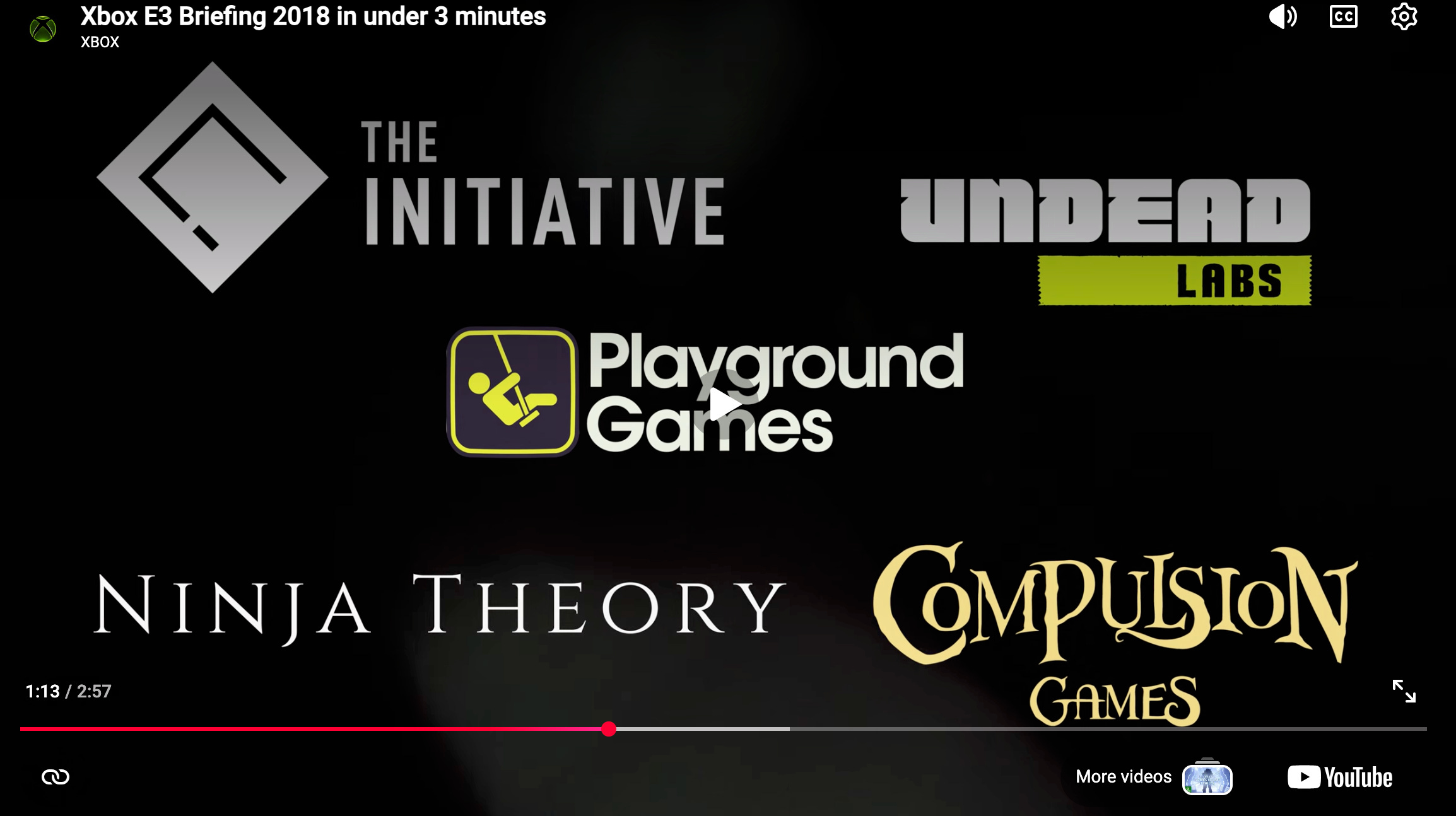
With DoubleFine also on the way out, most of Xbox’s 2018-2019 studio acquisition spree will be undone.
In surviving and remaining part of Xbox, Playground is joined by InXile, maker of the upcoming Xbox/PC-exclusive Clockwork Revolution, and Obsidian, which released three games last year but has no announced project on the horizon.
Arkane Lyon is one of several studios Microsoft acquired when it purchased ZeniMax in 2021 that did not last. Since the deal closed, Microsoft has closed Arkane Austin (Dishonored, Redfall), mobile studio Alpha Dog (Might Doom), and Tango Gameworks (Ghostwire Tokyo, Hi-Fi Rush), the last of which was reconstituted by Krafton.
Remaining ZeniMax studios include Bethesda (Elder Scrolls), id Software (Doom), MachineGames (Wolfenstein, Indiana Jones) and ZeniMax Online Studios (Elder Scrolls Online).
The divested studios are vestiges of a bygone era of Xbox, when small and mid-sized teams were enlisted into Xbox to maintain a flow of new, often original games for Microsoft’s Game Pass service.
Sharma has publicly said that Xbox needs to refocus on core franchises—read the likes of Halo and Fallout—which are not obvious fits for the DoubleFines and Ninja Theories of the world.
Major downsizing of platform team
Microsoft’s platform team, encompassing hardware, marketing, Game Pass, is getting a substantial layoff.
“Our platform teams are 40% larger than they were at the start of this generation, even as our player base and playtime have declined,” Sharma said today.
The plan here is for Xbox to proceed with a smaller team, though just how much a group like that can be cut and still function effectively remains to be seen.
Microsoft is still planning to release the Project Helix console, still planning to operate Game Pass—a nearly $5 billion a year recurring revenue business, for which it’ll still sign new deals, the source privy to Microsoft’s plans told Game File.
Sharma said today that the platform team, in some cases, has 14 layers of management, which will be reduced to no more than five. That kind of metric suggests prior bloat, but the public has seen tech CEOs confidently slash allegedly oversized teams deeply before. The wisdom or folly of doing so is often quickly borne out in its impact on the product.
Divorce from past strategy
Sharma took over the Xbox group from longtime boss Phil Spencer in February and had warned her team in May that the games team would be “making hard choices about what we build, where we invest, and what kind of company we need to be going forward.”
Today, in explaining the cuts, she described a past strategy that did not his its growth targets and that has run smack into the reality of skyrocketing hardware costs that are causing hardware prices to spike at game companies and beyond. Wrote Sharma:
We entered Gen 9 with a smaller install base and a higher cost structure. To grow, we bet on Game Pass, multi-platform, and a broader portfolio of content. While those businesses have created meaningful value, they did not grow at the pace we expected. As that happened, our core business weakened, and we added more teams, more investment, and more time, hoping for a better outcome. And now the industry is facing the most severe hardware crisis in its history
…
We now find ourselves competing not only with the largest publishers, but also with smaller independent studios. It is neither possible nor desirable to own every great independent studio. We have also learned that we are not the best home for every type of studio; in a typical year, we lost 64 cents for every dollar we invested. As we reset XBOX, we will help independent creators succeed by providing open development tools and audiences to realize their vision
(The math on losing 64 cents per dollar pertains to the small/mid-sized studios Microsoft has added over the past decade, some of which are being divested now.)
Franchise shift
Two of Microsoft’s crown jewels, Minecraft and King (Candy Crush) will be moved within the company’s gaming organization to report directly to Sharma, instead of to the division’s content and studios chief Matt Booty.
Sharma considers Minecraft to have been massively underinvested, a source familiar with Microsoft’s plans told Game File. They noted that Roblox, the hugely popular platform for player-made games, and Minecraft, more or less the virtual Legos of gaming, were comparable in size six or so years ago. But they estimated that Roblox has been investing more than five times as much in its business as Microsoft has on Minecraft. Minecraft was funding much of the rest of the Xbox gaming team, the source said, rather than being deeply funded itself. (Correction: The preceding sentence initially mistakenly started with the word “Microsoft”; that was a typo, as readers who noted it to me inferred. Apologies for the confusion.)
Cuts that follow cuts and more cuts
The logic of Sharma’s cuts is that Microsoft had, in her past words, “over-extended” its gaming teams. The studio spin-offs are an acknowledgment that the company gorged on studios it couldn’t handle. Microsoft’s reputation for hands-off management of its studios, for free creative rein, is being swapped for talk of focus, for mining core franchises, for raising expectations that the biggest things Microsoft could be doing in gaming is what it’ll be doing.
But this focus is far from the gaming team’s first contraction.
Microsoft cut 1,900 gaming jobs in early 2024 after the close of its purchase of Activision Blizzard. It cut another 650 in September 2024. Did another large cut in July 2025 as part of 4% Microsoft-wide job cuts that also ended development of major announced and unannounced game projects (Perfect Dark, Everwild, Blackbird) and downsized its publishing team and their projects.
Thousands of people lost their Xbox jobs in recent years, and the assessment Sharma and her leadership team are now making is that that all wasn’t enough.
That’s a brutal and shocking reality for Xbox workers, who’ve trusted past and current leadership to steer a console-making behemoth successfully.
Xbox is now saying it won’t actually reduce investment in content this year, that it’s shifting its priorities to pursue the most likely avenues of success.
That’ll be little consolation to those losing their jobs in this latest round, pain Sharma acknowledged today. This time, does Xbox have the right plan? The proof will be in whether Microsoft finds itself announcing more massive Xbox gaming cuts in the years to come.
What bugs me isn’t restructuring down a 14-layer org… it’s that these companies don’t ever seem to be able to process the fact that this industry is like Hollywood: (1) you lose a lot on a lot of projects, and (2) you have tentpoles hold up the core business, (3) in order to finance the gambles that become future tentpoles.
It’s a three-legged stool, it doesn’t work without any one of them.
But because no one has a big-picture theory of the business cycle, their stools are always falling over and they’re always blaming the other two legs instead of asking why they didn’t invest in the third.
Stephen, you linked to your 2024 interview with Phil Spencer recently, and sheesh. The optimism he projected! What a contrast from now.
Sharma seems to have a very practical head on her shoulders, and from the sounds of things a fresh broom is definitely needed at Xbox HQ to do some corporate restructuring, a topic that doesn't particularly interest me beyond my selfish interest in wanting to see a brand I've always had a soft spot for, succeed.
Actually, what I keep thinking is such a shame is that for all of Spencer's ambitious bets, none of them paid out like they probably should have. And I don't think that's his fault! In isolation all of them were sensibly targeted to address gamer and Xbox-owner pain points:
* The studio acquisitions were meant to address Xbox not having enough first-party and exclusive titles.
* Game Pass addresses complaints about games being too expensive, about the volume of slop that floods places Steam, and new customers having libraries on other platforms. "Get an Xbox and have an instant library!"
* The Series X was specifically designed to be (on paper) more powerful than the PS5 after the underpowered Xbone couldn't keep up with the PS4. And the Series S was both an attempt to offer a low price entry point *and* a hedge against a component supply chain that Microsoft were predicting wouldn't be getting cheaper.
* Xbox games started appearing on PC as well because they're all money for Microsoft, and Play Anywhere gave them a really solid selling point vs Steam, which is very very hard to compete with.
In short: Spencer's leadership tried very hard to overcome some built-in competitive disadvantages, and gamers and general consumers alike just didn't reward them for it. One day someone smarter than me will figure out why that was exactly, but at the end of the day it probably just comes down to Sony's PS4 era being so damn good that nothing was going to dent it short of 343 delivering Halo Infinite on time for launch and not bungling the ongoing support.